The 29th September marks the feast of St Michael, the Archangel, or greatest of the angels – guardian against evil and darkness. This day is also known as Michaelmas and is used by many universities as the name of the autumn term. It is one of the quarter days, when rents used to be paid and debts settled. It comes close to the autumn equinox, when days and nights are of equal length. In the northern hemisphere summer will be fading, autumn draws on and the earth faces the onset of winter. Michaelmas coincides with a time of energy different to that of spring, when everything is bursting into life. Now, as fruits ripen, leaves turn colour and fall, the earth seems to draw in on itself. Energy is focussed inwards and downwards; plants close down their growing cycle and instead rebuild reserves for the next cycle of flourishing in the following year.
St Michael defeats Satan
Legend has it that St Michael fought – and won – a battle against Satan, casting him out of heaven. Satan fell to earth – and landed in a blackberry bush. He was so incensed that he spat on the blackberries, cursing them and giving rise to the belief that it was bad luck to pick and eat blackberries after this date. Instead they should be left as food for birds and other wildlife at a time when natural food supplies were fading.
Delicious fruit – but watch for the thorns!
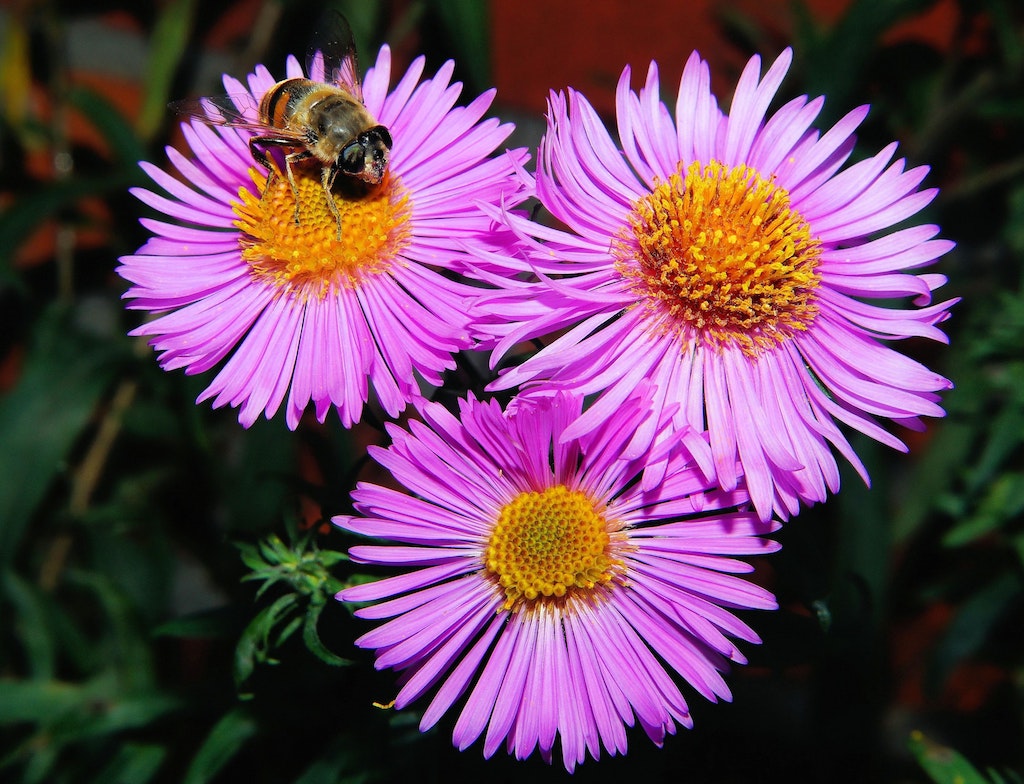
The Michaelmas Daisy flowers at this time – one of the last blooms of summer. The colouring is warm, gentle and glowing – a symbol of light in the fading gloom, just as indoor lamps and fires will guard against the darkness and chill of approaching winter.
When a seasonal heatwave seems to last an uncomfortably long time (especially when we’re not used to it!) it can be difficult to find relief from relentless sun, unusual temperatures and high humidity.
Relentless sun…
Cue the traditional but exotic lavender plant (of which there are many varieties.) A favourite in many countries lavender is native to the Mediterranean and wasn’t grown in England until the 16th century. Beloved of the ancient Greeks it was known as Nardus after the Syrian city Naarda, close to the banks of the Euphrates. Legend has it that this was the herb St Mark referred to as ‘spikenard’ in the Bible, used for producing aromatic oils for anointing and embalming. Whatever its origins and history lavender is now a delightful staple of English gardens.
Lavender – historic, soothing and fragrant
In his book RHS Companion to Scented Plants the garden specialist Stephen Lacey writes, ‘Lavenders have one of the most pleasant and nostalgic of herb scents, and on a hot summer’s day it can infuse the air and transport you to dry hillsides of southern Europe.’
…dry hillsides of southern Europe; perfect for growing lavender
The sight of its grey-green foliage and the stunning hues of its flowers – purple, white, deep blue and pale mauve – create a sense of well-being and calm, whether it is used as formal hedges and edging, or as a specimen plant in a tranquil corner of the garden.
Small lavender in shady tranquil corner of garden
And then, there’s the perfume…
Long known for its exquisite scent lavender has been used medicinally, cosmetically and in cooking. Lavender water is one of those traditional remedies that no home would dream of being without. Dabbed on the forehead it can bring relief from headaches and stress; it promotes a feeling of calm, tranquility and well-being. Lavender tea has a calming effect and a few drops of lavender oil added to a night-time bath or onto a pillow helps promote relaxation and sleep.
Gentle soothing lavender
In days past, young girls in needlework classes would often find that one of their early projects would be sewing a simple lavender sachet and filling it with dried lavender flowers from their gardens. This simple skill has become an art form; ‘children of any age’ now design interesting and imaginative lavender bags, or blend pot pourri for scenting rooms, drawers and cupboards – an ancient craft far more subtle and evocative than many artificial proprietary sprays and air-fresheners.
Delightful for scenting rooms, drawers and cupboards
Lavender-scented sugar used to be made by pounding lavender flowers with three times their weight of sugar. Cooking with lavender fell out of favour for a while but it now enjoys renewed popularity and recipes for cakes, biscuits, desserts – even roasts such as lamb – are now widely available.
Lavender – increasingly used in cookery
So next time you’re feeling the heat rub a sprig of lavender between your fingers and enjoy the instant cooling balm and relief it brings. Not for nothing did the street sellers of London cry:
Here’s your sweet Lavender, sixteen sprigs a penny,
Which you’ll find, my ladies, will smell sweet as any.
For many children on long car journeys the cry is often, ‘Are we nearly there yet?’ As a child my cry was always, ‘Will we be going through a tunnel of trees?’
A tunnel of trees
I always found travelling a long stretch of road flanked by trees in full leaf enormously exciting – and if the canopy comprised interlinked leafy branches, creating a dark, slightly mysterious tunnel suggesting unfolding adventures then so much the better. This has continued into adult life and still I love to walk along a path that is overhung with a leafy roof, the cool green light filtering through and making ever-shifting patterns on the path as sunlight dances through the twigs.
There might be long straight tunnels with regular perfectly-formed tunnel walls of aged tree trunk, bark beautifully patterned, stretching to a pinpoint light at the end of the tunnel. Or it might be a curvy path – giving no idea of length or how far the darkness might last before coming out into the light. Tantalising in its uncertainty but with a continuing sense of mystery. The tunnels might be natural, or planted deliberately, festooned with flowers or foliage cascading over the path.
Gated pathway through trees
These tunnels might suggest ancient human routes, sunken paths formed over the years and worn away and downwards from the stepping of countless feet.
It might be a formal avenue, a word from the French avenir, meaning ‘to reach, or to arrive,’ or it may be a natural holloway – from the Anglo-Saxon words hola weg, meaning a ‘harrowed path’, or ‘sunken road’. These ancient tracks would probably have started as ancient drove roads for moving cattle to different pastures or to market. Some will have grown as pilgrim paths, followed by the faithful in their journeys to sacred shrines and places of worship.
A sunken path will have a history of its own…
In his book The Wild Places Robert MacFarlane writes ‘These holloways are humbling, for they are landmarks that speak of habit rather than suddenness. Trodden by innumerable feet, cut by innumerable wheels, they are records of journeys to market, to worship, to sea.’ Each has its own story to tell; as we walk along them we continue that story as we create our own pilgrimage tale of experience.
A mysterious winding path leading up through woodland
We need to enjoy tunnels of trees wherever we can find them. Some have lasted years and speak of history; others will be more transient as they are changed or adapted to whims of landscape and garden designers. But they can instil in us a sense of wonder, peace and enchantment. The plaintive cry, ‘are we nearly there yet?’ will become more of a spellbound whisper ‘let me linger a little longer.’
Enjoy the tunnels of trees and let the path carry you onwards…