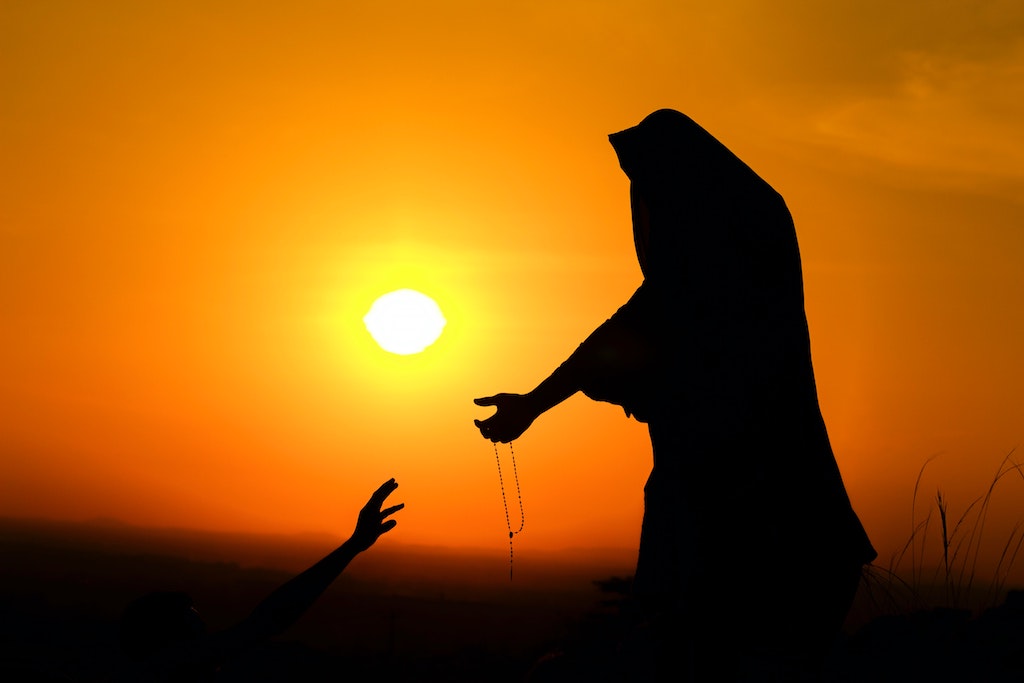
Ash Wednesday: the beginning of Lent

Ash Wednesday marks the beginning of Lent in the Christian calendar. Traditionally it is a time of penitence and fasting, reflecting the forty days that Jesus spent in the wilderness. Ash is often made by burning the previous year’s palm crosses. In a simple ceremony penitents are marked with the sign of the cross in ash on their foreheads, a reminder of the frailty of human life. ‘Dust thou art and to dust thou shalt return.’

Solitary figure in the desert
Out into the wilderness

The solemnity of this season comes, perhaps, at a time this year when we may be feeling a bit ‘down’ anyway and not in need of yet more reminders of the fragility of our mortal life. A long winter, a long lockdown, a strange way of living – it’s tempting to want to break free from all the restrictions – we may not want the additional discipline and rigour of Lenten fasting and abstinence.

But Lent is also a good time to remind ourselves that, despite the trials and tribulations of the current times, we are all loved and valued by God. Jesus’ time in the wilderness comes right after his baptism  – that occasion when a voice came from heaven saying, ‘This is my beloved.. with whom I am well pleased.’ (You can read the story in Matthew’s gospel, chapter 3.)

The wilderness; an inhospitable place

God knows his Son very well – he knows he is ready to start out on his ministry. That ministry begins with a time spent in the desert – away from family, friends and home, subject to alien voices that don’t comfort but bring challenge and temptation.

‘My beloved’

But Jesus knows that he needs to hold on to the memory of the voice that strengthened him at his baptism. Each one of us goes through wilderness times – when our faith feels feeble, weak and unreliable. It may be a time when we need to do some hard heart-searching, seeking again those elements of our faith that enable and help us to live in this amazing world – even when that world feels odd and dislocated. It is a time for renewing our prayer life – and much of the time that will mean listening out for God rather than bombarding him with endless lists of requests and anxieties. God often come to us in the silence, in the wilderness, in the emptiness. We need those empty times so that our inner resources can be healed and restored, enabling us to start out again on the journey that God sends us.

Unexpected flower in the wilderness
A bloom in a barren place

And don’t forget – when the rains come and the wilderness blooms it can be an amazingly beautiful sight. Treasure those blooms…

The Legend of St Valentine

St Valentine’s Day falls on 14th February. The precise identity of St Valentine is not known. Several early Christian martyrs were named Valentine; each became a martyr due to their adherence to the Christian faith in the face of persecution. ‘Love’ was the common theme – love of God and love of fellow man, together with a desire to spread the Christian message to as many as possible.

Who was Valentine?

One record describes Valentine as a priest of Rome, imprisoned for aiding persecuted Christians. After arrest he engaged in a long conversation with Emperor Claudius – who was impressed by his arguments but, unable to relent, tried to persuade Valentine to convert to Roman paganism in order to save his life. Valentine refused. He was unable to convert Claudius to Christianity but on the eve of his execution he allegedly healed Julia, the blind daughter of Asterius, his jailer. Valentine wrote Julia a card and signed it ‘Your Valentine’; this has become a symbol for love and friendship ever since. As a result of Julia’s healing the entire household were baptized and Julia planted a pink-blossomed almond tree near Valentine’s grave. Today, the almond tree remains a symbol of abiding love and friendship.

Pink spring blossom
Early spring blossom

Why celebrate Valentine?

Valentine’s Day falls in the middle of February, when the days are lengthening in the northern hemisphere and signs of spring appear. Birdsong builds in volume; we see garden and wild birds establishing their territory and many pair up and engage in courtship rituals. Thus Valentine’s Day becomes a special day for all lovers and is celebrated with flowers, hearts and cards.

Spring courtship rituals get under way…

An 18th Century rhyme gives us a flavour of Valentine romance:

The rose is red, the violet's blue,
 The honey's sweet, and so are you.
 Thou art my love and I am thine;
 I drew thee to my Valentine:
 The lot was cast and then I drew,
 And Fortune said it shou'd be you.

from Gammer Gurton’s Garland (1784)

Traditional Valentine greeting

“The rose is”The rose is red, the violet’s blue,red, the violet’s blue,

Conversion of St Paul

The 25th January is the date on which the Christian church marks a dramatic event in the life of St Paul. Paul – or Saul as he was initially known – became one of the chief apostles of the early church. After being convinced that his mission was to persecute the early followers of Jesus Christ he underwent a life changing conversion whilst on his journey from Jerusalem to Damascus.

Paul seeing a vision of the ascended Jesus
The Conversion of Paul

A vision of the ascended Jesus in brilliant light asking why he was persecuting him left him blinded. He was brought by his companions to the house of Ananias, a follower of Jesus, who cared for him and restored his sight. From that moment Paul began to preach Jesus of Nazareth as the long awaited Messiah and hope of the world.

Paul was responsible for much of the New Testament writings in the Bible. Some of his attitudes can seem outdated by modern standards but one of the most beautiful examples of his work comes in the first of Paul’s letters to the church at Corinth. It is sometimes called ‘The Hymn of Love’ and can be found in Chapter 13 of the First Letter to the Corinthians. It is an inspiring piece and has brought hope and comfort to many, often being read at both weddings and funerals.

Bride and groom on wedding day
Wedding Day

The passage finishes with the well known words, ‘And now faith, hope, and love abide, these three; and the greatest of these is love.’

Pilgrim's Perch
Privacy Overview

This website uses cookies so that we can provide you with the best user experience possible. Cookie information is stored in your browser and performs functions such as recognising you when you return to our website and helping our team to understand which sections of the website you find most interesting and useful.